Introduction
When sourcing from dried sweet potato suppliers, deep knowledge of the raw material varieties, grade standardisation and nutritional profile becomes a strategic advantage. Vietnamese processing plants draw on multiple sweet potato cultivars with differing flesh colour, starch content and drying behaviour. Understanding these variables helps importers specify finished moisture, slice thickness and product grade. This article covers the key varieties used in Vietnam, the grade expectations for export-ready dried sweet potato and the nutritional facts you should communicate to buyers.
Key Sweet Potato Varieties Used for Drying in Vietnam
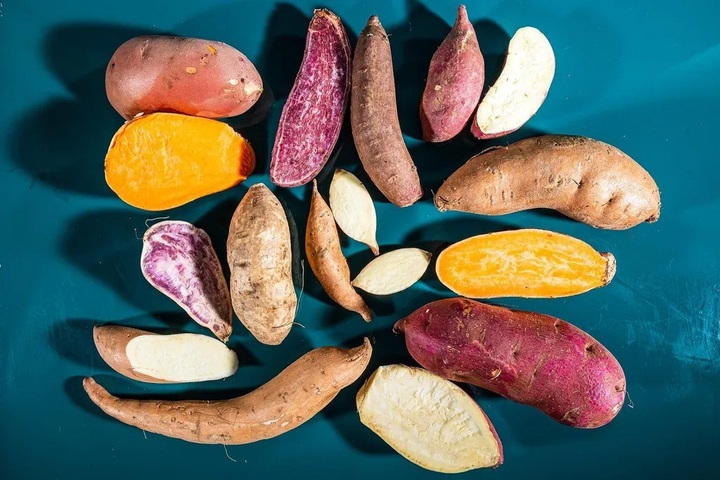
Vietnamese dried sweet potato suppliers typically select varieties that optimise drying yield, colour stability and product texture. Here are common characteristics:
- Orange-fleshed varieties (high β-carotene): These yield vibrant finished colour and higher vitamin A potential. According to USDA research, orange-fleshed sweet potatoes have high β-carotene and phenolic compounds. ARS+1
- Purple-fleshed varieties: These offer anthocyanins, providing unique finished product variants for premium markets. The U.S. government research states purple-fleshed sweet potatoes are speciality types in Asia. ARS
- White/cream-fleshed types: While less vibrant, they often have higher dry-matter content (> 25 %) which supports crisp texture after drying. ARS
For example, if a dried sweet potato slice is manufactured from a high-dry-matter cultivar (say > 28 % dry matter) the drying energy and shrinkage are lower, supporting higher yield. Importers should ask the supplier: “What cultivar (or variety) was used, and what is the typical fresh dry-matter percentage of the tubers?”
Internal link: Explore manufacturer sourcing and formats at dried sweet potato factory OEM Vietnam.
Grade Standards and Specifications for Export-Ready Dried Sweet Potato
Importers should set clear grade and specification standards to ensure consistent quality from supply-chain to product. Here is a table you can present in your RFQ:
| Specification Item | Target Value / Range | Why It Matters |
|---|---|---|
| Finished moisture content | ≤ 10 % | Ensures stability, crisp texture and low microbial growth |
| Water activity (aₜ) | ≤ 0.60 | Critical for shelf life and stability |
| Slice thickness | 2 mm – 4 mm | Uniform dryness and customer presentation |
| Dry-matter content of raw tubers | ≥ 25 % dry matter | Affects yield, drying energy and texture |
| Flesh-colour class (orange/purple/cream) | Defined as per customer requirement | Colour defines product grade & consumer appeal |
| Packaging barrier specification | Multi-layer film (e.g., PET/AL/PE), nitrogen flush or vacuum | Maintains freshness in export logistics |
By including this table in your supplier negotiation, you demonstrate specification discipline and technical understanding.
Internal link: Learn about private-label dog treat formats at import dried sweet potato dog chews.
Nutritional Facts and Health Positioning of Dried Sweet Potato
While nutrition is more often discussed for fresh tubers, understanding the nutrient baseline helps you position the dried product (while acknowledging that drying may concentrate some nutrients and reduce others). Key data points for fresh sweet potato:
- Raw sweet potato (100 g) contains approximately 86 kcal, 20.1 g carbs, 4.2 g sugar, 3 g fiber, 1.6 g protein, and 0.1 g fat. Healthline
- A 130 g serving of sweet potato (5″ long) provides 112 calories, 26 g carbs and 4 g fiber. SNAP-Ed Connection
- Orange-fleshed types contain significant β-carotene, contributing to vitamin A requirements; research confirms high β-carotene in processing-suitable cultivars. ARS
In dried form, since moisture is removed, nutrient density per gram increases (e.g., fibre and micronutrients per gram). As an importer you should ask your supplier for lab analysis of the finished product (e.g., fibre g/100 g, β-carotene µg/100 g, total carotenoids mg/kg) so you can market accurately.
Internal link: For packaging and format insights see dried sweet potato from Vietnam why importers prefer it.
What Importers Should Ask Suppliers Regarding Varieties and Grade
Here are actionable questions that help you evaluate a supplier and secure the specifications you need:
- Which cultivar(s) of sweet potato are used? What is the fresh tuber dry-matter percentage for each volume run?
- What slice thickness and drying-method (temperature/time) is applied? Supplier should supply actual internal data (e.g., “We dry at 75-80 °C for approx. 4 hours until moisture ≤10 %”).
- What grade codes are used for raw tuber sorting and finished slice sorting (for example Grade A <2 % defects, Grade B ≤5 % defects)?
- Do you offer grading by flesh-colour class (e.g., orange-fleshed vs. purple-fleshed) and provide colour-reports or spectrophotometer readings?
- What packaging barrier film specification is used (oxygen transmission rate, moisture vapor transmission rate) and what shelf life is guaranteed under standard export conditions (e.g., 12–18 months at ≤ 25 °C)?
By asking these, you shift from general sourcing to technically robust supply-chain management.
Internal link: Supplier profile including wholesale formats at dried sweet potato supplier wholesale.
Benefits of Specifying Varieties and Grades for Your Import Strategy
Here are key advantages you gain by specifying variety and grade standards:
- More consistent finished product appearance and yield: when the cultivar inventory is controlled and tubers meet dry-matter specification, drying yield improves and less trimming is required.
- Better nutritional claims: using high-β-carotene cultivars supports “rich in vitamin A” type marketing claims when finished product is analysed.
- Premium differentiation: purple-fleshed or unique-colour slices can command premium positioning in snack, pet-treat or health-food channels.
- Reduced logistic risk: when moisture, thickness and packaging are controlled by grade, you reduce spoilage, stack-compression loss or moisture-ingress during shipping.
How to Incorporate This into Your Import Due Diligence
Here is a practical step-by-step sequence for an importer engaging with a Vietnamese dried sweet potato supplier:
- Request technical specification sheet including variety, expected dry-matter %, slicing details, target moisture, water activity and finished size range.
- Receive sample production run: evaluate moisture, texture, thickness uniformity, colour and packaging integrity.
- Confirm grade acceptance criteria (e.g., defect levels, colour tolerances, moisture tests).
- Review packaging spec: film structure, nitrogen flush, bag weight variance, palletization details; ask for lab reports where possible.
- Confirm export documentation and traceability: raw-material origin, cultivar lot code, processing date, finishing date, batch analysis report.
- Put supply contract covering grade, specification, lot-codes, escalation/penalty for nonconformance.
Internal link: Contact for manufacturing support at product dried sweet potato.
Conclusion
For importers seeking dependable sources of dried sweet potato from Vietnam, understanding the underlying variety, grade structure and nutritional profile transforms sourcing into a strategic advantage. By setting clear specifications on dry-matter, slice thickness, colour class and finished moisture, and by selecting reputable manufacturers, you secure consistent product quality, yield and market positioning. If you want to import dried sweet potato from a trusted Vietnamese manufacturer using private-label or custom-grade specifications, consider partnering with a reliable OEM/ODM partner. Contact Qualitex Global for full support with specification, manufacturing and export-ready logistics.
FAQ Section
A1: A common benchmark is ≤ 10 % moisture and water activity aₜ ≤ 0.60. This supports shelf-life stability and crisp texture.
A2: Orange-fleshed cultivars are preferred for high β-carotene; this supports stronger vitamin A content. You should ask for lab analysis of finished slices for carotenoids.
A3: Slice thickness in the range 2-4 mm is common. Thicker slices might retain moisture and compromise shelf-life; thinner slices may over-dry and become brittle away from specification.
A4: Demand high-barrier multi-layer film (e.g., PET/AL/PE) with nitrogen flush or vacuum, labelled with lot code, origin, and featuring export-ready palletization. Good packaging helps maintain quality during long overseas transit.
A5: Ask for cultivar name, fresh dry-matter %, batch-lot code, processing date, color class of tubers and supplier’s sorting/grading protocol. A credible supplier provides this as part of quality assurance.